This Playlist of 2000s Hip-Hop is the High School Nostalgia You Need Today

This here is the good stuff. The good stuff from the good ol’ days. So, let’s all for a moment forget our boring adult responsibilities and think back to a time when everything was fresh and new…when your hormones made the decisions and when your only worries were what was happening on Friday night (likely nothing) and whether your crush would ask you to Sadie Hawkins (she would not).

Events from high school often become our most vivid and longest lasting memories. It’s what psychologists call the reminiscence bump — the theory that your brain places special meaning on adolescent experiences because this is when you form your identity. It’s when you become you.

Our brains are especially fond of music from this time period, as music stimulates the brain’s pleasure circuit and makes us feel good. Combine this flood of positive emotion with the reminiscence bump and what do you get? Musical nostalgia, a love for your high school soundtrack that endures regardless of how your tastes might otherwise mature. Now, let’s get to it.

Editor’s note: Song previews are available within the individual Spotify players below. You can listen to the playlist in its entirety using the links at the bottom of this post. 

City High – What Would You Do?

  • Released: February, 2001
  • Peak position on the Billboard Hot 100: 8
  • Fun fact: Claudette Ortiz, City High’s only female member, dated both of her male bandmates. The group disbanded after 3 years and released only one album.

Cam’ron – Hey Ma

  • Released: August, 2002
  • Peak position on the Billboard Hot 100: 3
  • (Not so) Fun fact: In 2005, Cam’ron was shot in both arms during a botched carjacking of his diamond studded Lamborghini Gallardo. He then, allegedly, drove himself to the hospital. The shooter got away.

JLo feat. Ja-Rule – I’m Real

  • Released: September, 2001
  • Peak position: 1
  • Fun fact: In 2007, JLo finished number 1 in In Touch magazine’s countdown of Best Bottoms in Hollywood. I think I speak for all teenage boys of the early 2000s when I say well deserved.

R. Kelly – Ignition (Remix)

  • Released: November, 2002
  • Peak position: 2
  • (Not so) Fun fact: In 2003, R. Kelly was arrested on 12 counts of child pornography possession. In 2008, he was acquitted of all charges.

Fat Joe feat. Ja-Rule & Ashanti – What’s Luv?

  • Released: February, 2000
  • Peak position: 2
  • Fun fact: In 2003, “What’s Luv?” was nominated for the Grammy for Best Rap Performance by a Duo or Group. It lost to OutKast’s “The Whole World”.

Twista feat. Kanye West & Jamie Foxx – Slow Jamz

  • Released: December, 2003
  • Peak position: 1
  • Fun fact: In 1992, Twista made The Guinness Book of World Records for being the fastest rapper in history. He spit 598 syllables in less than a minute.

Nelly – Ride Wit Me

  • Released: January, 2001
  • Peak position: 3
  • Fun fact: In 2016, Country Grammar became just the 8th rap album to be certified diamond for selling over 10 million copies.

Chingy – Right Thurr

  • Released: May, 2003
  • Peak position: 2
  • Fun fact: A buddy of mine kept Chingy’s Jackpot album in his car CD player for our entire senior year. I’d be fine if I never hurrd Chingy again.

Fabolous – Into You

  • Released: July, 2003
  • Peak position: 4
  • Fun fact: For an even more fabolous version of this song, watch Childish Gambino do it here

Ashanti – Foolish

  • Released: January, 2002
  • Peak position: 1
  • Fun fact: Ashanti dated Nelly for 9 years. They split in 2012.

Bone Thugs-N-Harmony – Ghetto Cowboy

  • Released: November 1998
  • Peak position: 15
  • Fun fact: “Ghetto Cowboy” was originally released as a single off the Mo Thugs album Chapter II: Family Reunion and features only two Bone Thugs members, Layzie and Krayzie.

D-12 – Purple Pills

  • Released: June, 2001
  • Peak position: 19
  • (Not so) Fun fact: In 2006, Proof — D12 band member and longtime friend and Best Man of Eminem — was shot to death in a Detroit nightclub following an altercation over a pool game.

50 Cent – 21 Questions

  • Released: April, 2003
  • Peak position: 1
  • Fun fact: In 2015, 50 cent filed for bankruptcy with a debt of $32.5 million.

Mase – Welcome Back

  • Released: May, 2004
  • Peak position: 32
  • Fun fact: Welcome Back was Mase’s comeback album after he took a 5 year hiatus from the music industry to become a minister.

Eminem – Drug Ballad

  • Released: May, 2000
  • Peak position: Not released as a single
  • Fun fact: The Marshall Mathers LP was criticized by the US State Senate, heavily protested by GLAAD, and of its 14 tracks, 9 depict killing women through choking, stabbing, drowning, shooting, and head and throat splitting. It is the second best selling rap album of all time.

Dr. Dre – The Next Episode

  • Released: July, 2000
  • Peak position: 23
  • Fun fact: In 2016, Dre’s net worth was $710 million, second only to Sean ‘Puff Daddy’ Combs among wealthiest hip-hop artists.

Bubba Sparxxx – Ugly

  • Released: August, 2001
  • Peak position: 15
  • Lyrics burned forever into my brain: Buckle up, cuz it’s gonna get bumpy. I call my girlfriends bettys and my shits grumpies.  

Jagged Edge feat. Nelly – Where the Party At

  • Released: May, 2001
  • Peak position: 3
  • Lyrics burned forever into my brain: The entire Nelly verse.

DMX – Party Up

  • Released: June, 2000
  • Peak position: 27
  • Lyrics burned forever into my brain: Your old man say you stupid. You be like, so? I love my baby mother, I never let her go. 

OutKast – Roses

  • Released: May, 2004
  • Peak position: 9
  • Fun fact: Speakerboxx/The Love Below is currently the best selling rap record of all time. However, being a double album, each disc counts toward total sales. As of 2016, it had sold 11.4 million units, while The Marshall Mathers LP — a single album — had sold 10.6 million.

Trick Daddy – I’m a Thug

  • Released: March, 2001
  • Peak position: 17
  • Lyrics burned forever into my brain: Give me half a pill and some zinfandel, and I’m like fuck it, dog. 

Kanye West – All Falls Down

  • Released: February, 2004
  • Peak position: 7
  • Lyrics burned forever into my brain: Rollies and Pashas done drove me crazy. I can’t even pronounce nothing, pass that ver-say-zee.

Ol’ Dirty Bastard – Got Your Money

  • Released: August, 1999
  • Peak position: 26
  • Fun fact: YouTube has an isolated vocals version of “Got Your Money”. The quality is poor, but hearing ODB stripped down is worth the listen.

Mystikal – Shake Ya Ass

  • Released: July, 2000
  • Peak position: 13
  • Fact: “Shake Ya Ass” was produced by the Neptunes (Pharrell Williams and Chad Hugo) and features uncredited vocals from Pharrell.

Ludacris – Rollout (My Business)

  • Released: October, 2001
  • Peak position: 17
  • Lyrics burned forever into my brain: Now, who’s that bucked-naked cook fixing three-course-meals. Getting goosebumps when her body tap the six inch heels. 

Lil Jon & The East Side Boyz & Ying Yang Twins – Get Low

  • Released: February, 2003
  • Peak position: 2
  • Fun fact: ‘Crunk‘ is considered its own sub-genre of hip-hop. Performers of crunk music are sometimes referred to as ‘crunkmeisters’.

Akon – Lonely

  • Released: February, 2005
  • Peak position: 4
  • Fun fact: “Lonely” samples Bobby Vinton’s 1962 “Mr. Lonely“.

Afroman – Because I Got High

  • Released: July, 2001
  • Peak position: 13
  • Fun fact: Afroman told Rolling Stone that “Because I Got High” took 2 minutes and 11 seconds to write and was inspired by some chronic weed. It was nominated for a Grammy in 2002.

Big Tymers – Still Fly

  • Released: March, 2002
  • Peak position: 11
  • Lyrics burned forever into my brain: Wassup Fresh? It’s our turn, baby. 

Snoop Dogg feat. Pharrell – Beautiful

  • Released: January, 2003
  • Peak position: 6
  • Fun fact: “Beautiful” was the second single off Snoop’s 6th studio release, Paid the Cost to Be da Boss. This album and its 5 predecessors are all certified platinum.  

The Playlist

Listen to the playlist in its entirety using the links below.

Spotify (free Spotify account required)

YouTube (navigate using the playlist icon in the upper left corner)

Apple Music (Apple Music account required)

Apple Music


Newsletter

Sign up for our weekly newsletter and receive pipin’ hot content delivered directly to your inbox. Upcoming posts include The 10 Commandments of Driving Etiquette and 9 Things Every Guy Should Know About the Female Brain. Join today!

11 Ways to Love Your Dog

Dogs are the best, and anyone who says otherwise is either some weirdo cat person or some awful, black-hearted hater. But as for the rest of us, dogs rule. They make us healthier, happier, and provide us with the closest thing there is to unconditional love. So in appreciation of our furry little friends, here now are 11 ways you, the loving dog owner, can return the favor.

11. Create Rituals

Dogs are experts on human behavior. We control their schedules, so they spend their days attuned to our every move. They learn putting on a coat precedes a walk and opening the pantry means it’s time to eat.

You can use your dog’s association skills to create fun little rituals. Give him a treat when he comes in from the bathroom or an after-dinner bone when he finishes his kibble. When you’re ready to leave for a walk, say, “Walk, boy?” and watch him lose his damn mind. Daily doses of fun and excitement strengthen the bond between man and mutt, but maybe the most important ritual of all is saying hello.

10. Say Hello

When I come home, guess who’s most excited to see me. HINT: it’s not my wife or daughter.

Studies show that when caretakers return home, a dog experiences bliss-fueled energy and a desire for physical contact. His happy feet and thundering tail are signs of his excitement; he’s so elated he could run around the block. But he contains himself in favor of a physical greeting with his human. I know there are a million things to do between returning home from work and going to bed, but make time for a proper greeting. Your dog has been waiting for it all day.

9. Scratch His Favorite Spots

Researchers have long known that when humans pet a dog, it floods our brains with endorphins, oxytocin and dopamine — chemicals that make us happy and promote love and bonding. However, more recent research suggests that touch can have a similar effect on our dogs.

Dogs even have preferred touch zones and will move to position these favorite spots directly under your hand. In general, dogs like to be touched on the sides of the head, base of the tail, around the ears, and on the belly.

8. Train Using Positive Reinforcement

Dogs are not wolves, and the theory that a dog believes he is part of a wolfpack is not only incorrect but toxic to the human/dog relationship. The dog does not consider you his alpha male and will therefore not challenge your rank if you fail to display dominance over him.

When it comes to raising a happy and obedient dog, positive reinforcement beats punishment; punishment only beats the dog. Dogs aim to please, so make training a happy time filled with lots of praise and treats. Now, WHO’S A GOOD BOY?

7. Let Him In the House

A dog is domesticated; his natural environment is with his family in the home. He shows an attachment to his caregivers that, according to some researchers, is strikingly similar to that between an infant and its mother. A dog has social needs just as he needs food and water. And remember the need for physical contact? An owner’s return home must be torture for the poor boy tied to a tree in the backyard.

6. Let Him Stink

Dogs and humans have different definitions of what smells ‘good’. For example, a just-bathed dog still fresh with the scent of his Creme de la Coco doggy shampoo is a smell us humans might find favorable. But to a dog, an animal that will willingly roll in a pile of shit and be glad he did so, artificial scents can be overwhelming. If the dog is gonna be in the house, obviously he will periodically need a bath. But a dog’s sense of smell is millions of times more sensitive than ours, so remember that before you cover him in fancy shampoo.

5. Let the Stinky Boy Sleep in Your Stinky Bed

Dogs aren’t the only creatures that stink; humans stink, too. Our breath stinks. Our feet stink. Our armpits and genitals — they stink. We leave a trail of our unique scent wherever we go and it collects in our favorite places. To a dog, an expert sniffer and master of association, our stink is us. And our bed, where we spend hours every night snuggled between layers of sheets and blankets, reeks of us. To him, there’s no place more comfortable than a soft flat surface soaked in the scent of his human. It doesn’t matter if it’s a Sealy or a Serta.

4. Play P.S. I love You

For those who don’t know, P.S. I love You is a chick flick starring Gerard Butler and Hilary Swank. When Butler’s character is diagnosed with a terminal illness, he masterminds a series of surprises that will be delivered to his widow (Swank) once he’s gone. The little gifts help Swank escape her loneliness and the accompanying letters eventually lead her to a rediscovery of love.

Anyway, dogs need stimulation and that need doesn’t stop just because you’re at work for 10 hours. So take a page from The Book of Gerard, and surprise your dog while you’re gone. Doing so will prevent loneliness, boredom, and property damage that often goes hand in hand with a bored pup. Here are a few ideas (click links to see on Amazon):

3. Build Him A Hangout

Give your dog his own place. Put his bed or crate somewhere off the beaten path but still in earshot of all the action, maybe an office or sitting room adjacent to the main living area. Add a blanket or some of his toys to make it ‘his’.

This is especially important if you have kids. As any honest parent will tell you, kids are often very annoying. They can be especially irritating to a dog — tugging his tail, taking his toys, etc. Over half of all dog bites occur at home with dogs that are familiar to us. Providing the dog with a safe retreat, and of course keeping kids out of said retreat, gives him an escape when he’s not in the mood to have his ears pulled.

2. Take a Walk

Regularly scheduled walks are probably the best thing you can do for a dog. They provide physical and mental stimulation, promote bonding, and offer plenty of fun items to sniff. In fact, dogs love walks so much, we’ve dedicated an entire post to it: Why Dogs Love Walks: Inside the Mind of Man’s Best Friend.

1. Remember He Depends on You

Life is busy and dogs are a lot of work. With the demands of our jobs and kids and whatever else, it’s impossible for us to give the dog everything he wants. But we should do our best because to a dog, we’re his world — the provider of his physical, social, and emotional needs. We make his days and therefore his life.

Newsletter

Sign up for our weekly newsletter and receive pipin’ hot content delivered directly to your inbox. Upcoming posts include The 10 Commandments of Driving Etiquette and 9 Things Every Guy Should Know About the Female Brain. Join today!

Sources and Recommended Reading

Decoding Your Dog

Why Dogs Love Walks

For the Love of a Dog

Why Dogs Love Walks

Inside of a Dog

Why Dogs Love Walks

The Other End of the Leash

Why Dogs Love Walks

Has Evolution Hardwired Us To Be Unhappy?

Happiness is tough, man. No matter how ridiculously good life is in 21st century America, it’s so easy for that nagging worry, or rush hour traffic, or some shithead coworker to hijack your entire emotional state and ruin your whole damn day.

Now, more than ever, happiness should be easy. Our homes have electricity, running water, and can hold temperatures to a precise degree. Modern medicine has eradicated a handful of history’s most disgusting diseases. We have planes that can transport us to the other side of the world in less than a day. We have HDTV and the Internet!

We live in the pinnacle of human existence, but instead of skyrocketing happiness, the opposite is happening. Depression rates are 10 times higher than they were in 1960. Antidepressant prescriptions have increased 400% since 1988. And millennials especially struggle with depression, anxiety, and other mental health issues.

But in order to understand today’s struggles with happiness, we need to go way, way back to the early days of our ancestors.

How Evolution Primed Our Brains for Pessimism and Stress

For almost 60 million years our ancestors lived in small hunting-gatherer groups. Life was simple — there weren’t sales goals, traffic jams, or overflowing inboxes — but it was dangerous. You killed prey or you died. You escaped giant, man-eating predators or you died. You avoided illness, injury, and infection or you suffered for weeks, and you died.

The brain responded to dangers in the pre-civilized, pre-modern medicine world by shaping itself for what was most important: survival. It became paranoid, constantly scanning the environment for potential threats. It developed instincts, reactions, and biases to keep us safe. These tactics have baked into our brains for millions of years, but two in particular don’t vibe with life in the 21st century.

The Negativity Bias

Years ago, two types of motivation drove every human decision:

  1. Seeking pleasure
  2. Avoiding pain

Pleasure or ‘carrots’ included eating food, seeking shelter and sex. Pain avoidance or ‘sticks’ included avoiding starvation, predation and injury. Both carrots and sticks are important and necessary for survival, but they’re not equally important, right?

If you fail to get a carrot today — let’s say you chuck your spear at a woolly mammoth and miss — you can retrieve the spear and be alive to throw it again tomorrow. But if you fail to avoid a stick — say you believe there isn’t a saber toothed tiger in the bushes when there is one — then there is no tomorrow.

Because of this, our brain developed what Ph.D. and bestselling author Rick Hanson calls the negativity bias, a system of thought designed to keep us safe by overestimating threats and avoiding risks. This bias is still in our brain today, influencing our actions as we deal with conflict, present in meetings, and argue with our spouses.

The Fight-or-Flight Response

Imagine you’re a caveman. You’re eating spit-roasted rabbit in your little cave house with your sexy cave lady when — OH MY GOD WTF IS THAT!? — the tiger from the bushes barrels through your front door.

Your eyes perceive the tiger and send a signal to your brain. The amygdala, the emotional processor of your brain, alerts the hypothalamus of a threat. The hypothalamus calls for the stress hormone cortisol to flood your bloodstream.

In an instant your heart rate skyrockets, pupils contract, and muscles tense. You experience tunnel vision and adrenaline catapults you into action.

Without consciously knowing it, you will do one of two things: grab your spear and go for the throat, or grab your cave lady and run for the back door. Fight-or-fight.

In this scenario, the best strategy is the quickest strategy. Any analysis or hesitation only increases the likelihood you’ll be eaten. Fight-or-flight overrides thought with action, because in a life or death situation action is your best shot at survival.

The Ancient Brain in the Modern World

We owe our very existence to these ancestral instincts, but today they do us no favors. In the modern world, our ancient brain is making us stressed and unhappy. Here’s how:

Prevents us from following our dreams. The negativity bias makes us overestimate threats. Historically, when threats were often life or death, this fear and paranoia kept us alive. But today, this bias makes us dream small. It says, “You can’t start that business. What if you fail?” or “Hannah’s way out of your league, bro. Ask her out and she’ll shut you down, and everyone will know about it.”

Makes us ultra-sensitive to bad news, even when it’s outnumbered by good news. This is why a single ‘needs improvement’ on your performance review overshadows ten ‘exceeding expectations’. Our negativity bias is a magnet for negative stimuli. We look for it, find it, and dwell on it. We believe things are not okay, when in reality things are just fine.

Destroys creativity and logical thinking. Complex modern problems require creativity, collaboration, and resilience and we’re trying to solve them with a pessimistic brain that panics when it’s stressed because it’s scared of prehistoric cats.

Stresses us out. Our nervous system has a function to calm us down after a fight-or-flight response. As long as stressful experiences are brief and infrequent, we automatically return to a resting state. But today — where mild stressors are delivered to our inboxes and voicemails and pinged to us 60 times a day by our bosses — we’re getting stuck in our reactive mode, and it’s stressing us out.

Chronic stress is responsible for about 80% of doctor visits and is linked to the six leading causes of death: cancer, heart disease, lung ailments, accidents, cirrhosis of the liver, and suicide. Additionally, prolonged stress has been shown to damage brain structure and connectivity.

Thankfully, researchers have discovered an antidote that can undo the effects of stress, enhance creativity, and even shift us away from our negativity bias. This new wonder drug is happiness.

Why it’s Better to be Happy

Happiness undoes the cardiovascular effects of negative emotion. When we’re stressed, we experience a hike in heart rate as our body sends blood to different muscles preparing us for a specific action like fight or flight. This constant fluctuation shifts our heart into overdrive and is thought to increase the risk of coronary heart disease. Positive emotion has been shown to speed recovery from cardiovascular reactivity and quickly return us to our resting state. So when we’re happy, we’re less susceptible to stress and anxiety. We can then spend more time in a neutral or positive mindset, which is important because…

Happiness expands the mind. While negative emotions limit our thoughts to induce action, positive emotions flood our brains with the feel good chemicals dopamine and serotonin — similar to the effect you’d get from a dose of ritalin. These chemicals activate the learning centers in our brain, increasing focus, motivation, and creativity. This is what researchers call “broaden-and-build”, a theory that suggests that positive emotions broaden the amount of possibilities we process and help us build more resources to use for problems in the future.

Studies related to this theory show that doctors put in a good mood before making a diagnosis reached the accurate diagnosis 20% faster than a control group of doctors in a neutral state of mind. Another study shows that optimistic salespeople outsell their pessimistic counterparts by 56%.

Happiness can be learned. Inside our brains are billions of neurons that connect to form neural pathways called synapses. Every thought, action, and feeling we experience is based on this underlying neural activity. The more we practice an action or think a certain way, the stronger the connection between neurons. This is what scientists refer to as Hebb’s Law — “Neurons that fire together wire together” — and it means that we can use experiences and mindset to change our neural structure. So just as our ancestors learned that the world was a dangerous place, we can re-learn that it’s really not so bad, and that today happiness is a safer and more effective alternative to anxiety and fear.

How Do We Get Happy?

So now we know that happiness is awesome and that, with practice, anyone can obtain it. But what we don’t know is how to obtain it. In the final two posts of this three part series, we’ll leverage research in psychology and neuroscience to lay down an easy-to-follow roadmap to happiness.

Feel free to leave your rose-colored glasses at home, because this won’t be a lesson in blind optimism or self-deception. The world is often a shitty and unfair place, and anyone who says otherwise is either dishonest or delusional. Yet this is another reason to train your brain for happiness: so you can be happy in spite of what you can’t control.

You’re about to discover that happiness isn’t so tough after all. You don’t need a fat salary or roaring success (thank god). You just need a little practice.


Newsletter

Sign up for our weekly newsletter and receive pipin’ hot content delivered directly to your inbox. Upcoming posts include The 10 Commandments of Driving Etiquette and 9 Things Every Guy Should Know About the Female Brain. Join today!


Sources and Recommended Reading

Before Happiness

Before Happiness

The Happiness Advantage

The Happiness Advantage

Hardwiring Happiness

Hardwiring Happiness

Your No Nonsense Guide to Leather Shoe Care

I don’t know how or when it happened, but it happened: we have turned the shoe shine into some inimitable world-class skill. Old-timey fashion blogs romantize the act like it’s an art and, no different from painting or sculpting, mastered only through thousands of hours of practice. Shoe care companies have saturated the market with products of every consistency: waxes, polishes, conditioners, cleaners, creams, balms, salves, milk, and honey.

Meanwhile, we, the common folk, are left trying to make sense of this nonsense. Do I use ALL of these products? If so, do I apply the shoe milk before or after the shoe honey? And, because I quite obviously don’t have hours of practice, is shining shoes even worth my time?

What follows is your no nonsense guide to leather shoe care — everything you need to keep your kicks looking fresh, and more importantly, nothing you don’t.

What You Will Need

Of the many shoe care products available, only a few are essential. Most shoes require a good shoe cream and some tools, while others — those worn in inclement weather, for example — require additional items. [Recommendations and links to product pages on Amazon are provided at the end of this post].

Products

  • Saddle soap – cleans dirty leather
  • Shoe cream polish – conditions, shines, and protects leather
  • Mink oil  – protects leather from inclement weather
  • Wax polish – protects leather and gives it a high shine

Tools

  • Old t-shirt – cheap and effective product applicator
  • Horsehair shine brush – works product deep into the leather
  • Shoe tree – absorbs moisture and helps maintain the shape of the shoe
  • Shoe horn – protects the back of the shoe from wearing down

How to Shine a Shoe

Step 1: Cleaning

Before applying any shoe product, it’s important to remove the dirt and dust that accumulates naturally on your shoes. Unless you’re stomping through mud puddles, all you need is a damp piece of an old t-shirt. If you are, for whatever reason, playing in the mud, then some saddle soap — a cleaner designed specifically for leather — can give you a deeper clean.

How do I clean my shoes?

  1. Wipe the shoe with a damp piece of an old shirt (use saddle soap if necessary).
  2. Wipe dry.
  3. Allow 5 minutes for shoes to fully dry before applying shoe care product.

How often should I clean my shoes? Weekly and always immediately before conditioning and/or polishing. The key is to prevent the buildup of dirt and dust, so frequent cleanings — like once at the end of the workweek — are most effective.

How long should I spend cleaning my shoes? 30 seconds.

Step 2: Conditioning and Polishing

Applying a cream-based polish to your shoes is the most important step to shoe care. A good shoe cream — like this one from Meltonian — is both a conditioner and a protectant. The conditioning components keep the leather supple and give the shoe that out-of-the-box look, while the polish/protectant components protect against scuffs, water, snow, and slush.

How do I apply shoe cream?

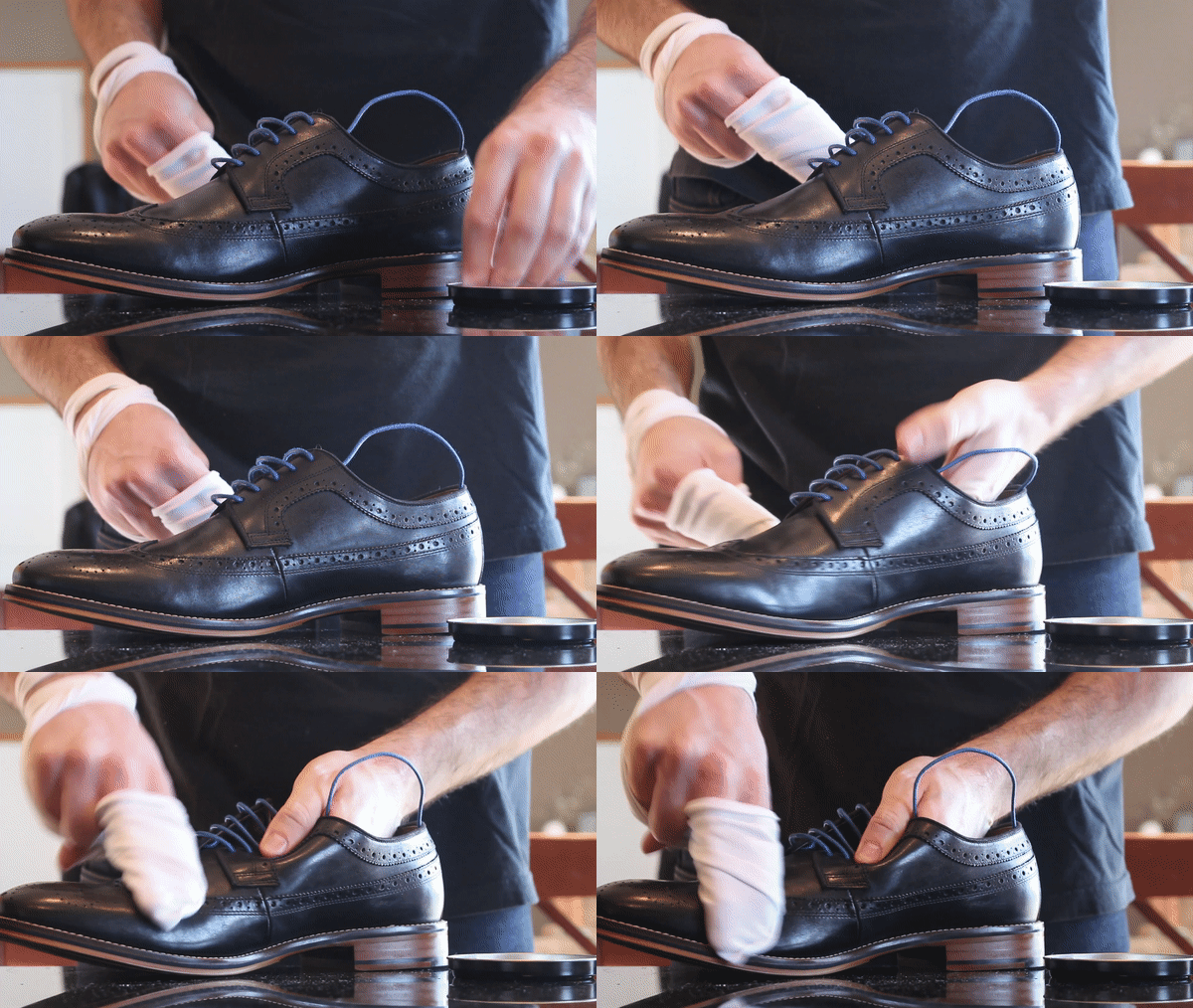
  1. Apply cream to your fingers. Rub it into the shoe like you’d apply lotion to your face. You can also use a rag, but your fingers will make it easier to apply a consistent coat and get into those hard to reach places.Shoe Cream
  2. Wait 1 minute to allow the cream to set in.
  3. Using a light stroke, brush the shoe with a horsehair brush. This will work the cream further into the shoe and remove any excess product.Brush Shoe
  4. Apply a second coat and rebrush. This will intensify the protective layer of polish.
  5. Spit the shoe. It’s time for the ol’ spit shine. Get some water on your fingers and mist the shoe. Take your t-shirt and wrap it around your pointer and middle fingers. Rub lightly using a circular motion to bring the cream forward for a healthy shine.Shoe Buff

Do I need to polish brand new shoes? Yes. Polish protects the shoe, absorbing minor scuffs before they reach the leather.

If I don’t want shiny shoes, do I need to polish them? Yes, for the reasons above. Cream polish gives your shoes a rich and healthy look. But it won’t give you that classic mirror shine that comes from wax-based polish (which we’ll cover shortly).

What color shoe cream should I use? Black or neutral. For the most part, black is black, and any black polish can be applied to your black shoe. For brown shoes, though; I’d use neutral. There are 42 shades of brown, and the last thing you want is to try to match polish and fail, altering the color of your favorite shoe.

How often should I apply shoe cream? Once a month.

How long should I spend applying shoe cream? 5 minutes.

Step 3: If Your Winters Suck, Consider Mink Oil

Mink oil provides maximum protection against snow, slush, and sidewalk salt, but it can also darken leather.

If you live somewhere nice (good for you), you can probably skip it. But if, like me, you live in Minnesota, where you’re punished with 7 months of wintery hell every year, it’s worth it to weigh mink oil’s protective benefits against the risk of darkening your shoe color.

You’re unlikely to notice a difference with black or dark brown shoes, but a light tan might turn a shade darker. If you’re unwilling to risk color change, skip mink oil and make sure to wipe your shoes down immediately after contact with salt and slush.

How do I apply mink oil? After conditioning the shoe, apply a single coat of mink oil as follows:

  1. Apply using fingers
  2. Brush
  3. Wipe off excess oil with the t-shirt

How often should I apply mink oil? Once every 2 months throughout winter.

Step 4: If You Want a High Shine, Apply Wax Polish

So let’s say you want a little shine. Maybe you’re a groomsman in a formal wedding and when you hit the dance floor, you want to SPARKLE. That’s cool. A wax polish gives you that mirror finish and is applied much like a cream polish.

How do I apply wax polish?

  1. Apply polish using your fingers.Polish Shoe
  2. Brush
    Brush Shoe
  3. Apply a second coat and re-brush.
  4. Apply a third coat. This is the base coat, and you won’t brush it off.
  5. Mist the shoe and using your shirt wrapped around your fingers, rub in a circular motion to bring the polish forward, giving the shoe that high shine.Shoe Buff

How often should I apply wax polish? As needed. In addition to shining your shoes, wax polish is your best bet to repair scuff marks and can be used to restore beat up shoes.

How long should I spend applying wax polish? 5 minutes.

Two More Tips for Extending the Life of Your Shoes

1: Use a Shoe Horn When Putting Shoes On

Shoe Horn

This will prevent the backs of your shoes from looking like this:

Shoe Damage

2: Insert Shoe Trees When Shoes are Not in Use

Shoe Tree

Shoe trees absorb moisture and maintain the shape of the leather, which prevents cracking. They also help decrease shoe odor.

Product Recommendations

Based on both personal experience and the research for this post, here is a list of recommended shoe care products and their Amazon links:

Fiebings Saddle Soap

Saddle Soap

Meltonian Shoe Cream Polish

Shoe Cream

Sof Sole Mink Oil

Mink Oil

Kiwi Wax Polish

Wax Polish

Kiwi Horsehair Shine Brush

Horsehair Brush

Shacke Metal Shoe Horn

Shoe Horn

Woodlore Shoe Trees

Shoe Tree

The Millennial Man participates in the Amazon affiliate program. Basically, if you purchase a product or service through a link on this site, we get a small percentage — compensation that covers a fraction of the cost and effort required to maintain this blog. Your support is very much appreciated.

Newsletter

Sign up for our weekly newsletter and receive pipin’ hot content delivered directly to your inbox. Upcoming posts include The 10 Commandments of Driving Etiquette and 9 Things Every Guy Should Know About the Female Brain. Join today!


Let’s Remember Your Favorite 90s Movies: D2

A look back at your favorite childhood movies in all their corny, nostalgic glory.

The Plot

The quack attack is back! Well, most of it is. About half actually. Half the quack attack is back, and joined by 5 new members, the former Ducks prepare to take on the world as Team USA in the upcoming Junior Goodwill Games.

Coach Gordon Bombay is also back and takes his spot behind the bench after a knee injury shatters his dreams of playing in the NHL. Hand picked by athletic apparel conglomerate and official Team USA sponsor, Hendrix Hockey, Bombay signs an unimaginably lucrative endorsement deal that makes him and Team USA overnight celebrities.

But can Bombay repeat his success with the Ducks on the national stage? And can Team USA defeat heavily favored Iceland and take home the gold? And just what in the fuck are the Junior Goodwill Games? All this and more right now as we remember D2!

The New Characters

Luis Mendoza

Luis Mendoza

Considered the most gifted skater in the country despite one very serious fault: He doesn’t know how to stop.

Dean Portman

Bash Bros

Useless as a standalone character, Portman’s value is tied to his relationship with equally pubescent big man Fulton Reed. Together they form the hard-rocking, bandana-wearing duo famously known as the Bash Brothers.

Dwayne Robertson

Dwayne Robertson

Cowboy from Texas whose family farm was apparently close enough to an ice arena where he was able to become the greatest puck handler in the world.

Russ Tyler

Russ Tyler

Street hockey junkie whose top-secret knucklepuck is further proof that any one trick pony can play for this goddamn team.

Kenny Wu

Kenny Wu

Former Olympic figure skater with no hockey experience.

Don Tibbles

Don Tibbles

Senior Vice President of official sponsor Hendrix Hockey Apparel. Tibbles was also responsible for the new recruits (except for Tyler who literally walks in off the street).

If I were Bombay, I would be livid with this guy. I’d be like, “Hey Don, why does each of my new kids have some glaring shortcoming? You had the entire country to choose from. Could you not find one complete hockey player? Mendoza can’t even stop, for Christ’s sake.”

Unanswered Questions

I preferred D2 to the original Mighty Ducks when I was a kid, because children are misguided and stupid. But take it from me, a now full-grown man who has seen D2 four times this week, this is an inferior movie. The plot unfolds without logic or explanation, and as a result I have a few unanswered questions.

Who at the Junior Goodwill Games is Checking Birth Certificates?

Iceland

Seriously, what is the average age on this Iceland team? These kids are either a) not children or b) on PEDs. I demand an investigation.

Why are the Bash Brothers Upset When They See Bombay Eating Ice Cream with the ‘Iceland Chick’?

Ice Cream

If the Bash Bros are so ‘hip’ and ‘with-it’, shouldn’t they be bumping chests and giving knucks at the mere thought of their wiener coach wheeling a younger and much more attractive trainer of a rival team? Be consistent with what you think is cool, Bash Brothers.

What Kind of Apparel Company is Hendrix Hockey?

Hendrix

As far as I can tell, Hendrix only manufactures the Team USA jersey. The gloves, sticks, helmets, etc. are all provided by actual, real-life equipment brands. This raises the question: how many jerseys will Hendrix have to sell to recoup the cost of this sponsorship, especially with Don Tibbles spending cash like he’s printing it? Let’s take a look at some of his more questionable expenses:

  • Signs Bombay to a lucrative endorsement deal
  • Puts Bombay up in a condo on the beach
  • Hosts a party at said condo
  • Hires catering and cocktail waitresses for said party
  • Hires models, makeup artists and fashion designers for a Bombay photo shoot

Why Doesn’t Team USA Have a Trainer?

Banks

So Hendrix ponies up for fancy hor d’oeuvres and Bombay’s posh condo on the beach but decides against any formal training staff? Meanwhile, poor Banks has a fractured wrist and Bombay, a man with zero medical experience, is diagnosing it using some bizarre stick rotation exercise. Worst sponsor ever.

What are the Junior Goodwill Games?

Junior Goodwill Games

I was surprised to learn that the Goodwill Games were a real thing in the 90s. There’s no mention of a ‘Junior’ competition, and if there were, no way was it the media circus this movie makes it out to be. But in a world where Flying Vs and roping penalties are the norm, the Junior Goodwill Games aren’t that far-fetched.

What is Bombay Thinking with that Duck Call?

Duck Call

Prior to the scene you see above, where Bombay strolls into a sold out arena in the middle of his team’s game blowing a duck call like some horse’s ass, he decides he needs to do a little soul-searching. So he straps on some rollerblades and cruises around on the beach. Meanwhile, his team, one loss away from elimination, nearly forfeits because they don’t have a coach. What are you doing? Get your shit together, Gordon.

Bombay’s Championship Coaching Strategy

This is the genius of The Minnesota Miracle Man, folks:

Tie Players Together to Promote Team Bonding

Bombay Tie

Analysis: Incredibly dangerous.

Line Dance

Bombay Line Dance

Analysis: An incredibly wasteful use of ice time.

Have Dwayne Rope Players Like They’re Cattle

Rope

Analysis: Just throwing that ice time away now.

Construct a Pop Can Wall to Teach Mendoza to Stop

Bombay Stop

Analysis: Incredibly unnecessary.

The Move Most Reenacted Throughout 90s Childhoods

Knucklepuck

It’s the knuckle puck, which is a pretty solid move because it actually works. Like, any snot-nosed kid with a stick and a street hockey puck can walk to the driveway and execute a decent knuckle puck.

Complimentary Quote for the Road

Bombay: I’m not a lawyer; I’m a player. I was this close to the NHL. I was back in the game, and MAN I was alive.

Newsletter

Sign up for our weekly newsletter and receive pipin’ hot content delivered directly to your inbox. Upcoming posts include The 10 Commandments of Driving Etiquette and 9 Things Every Guy Should Know About the Female Brain. Join today!

How to Survive a Bear Attack

Pssssst. Hey, you. Over here. No! Over here. Shhhhhhhh. Quiet, goddammit. They’ll hear us. They can smell us. They’re probably stalking us right now. We gotta move. Leave the kids. They’ll only slow us down. On second thought, get the kids. They’ll get eaten first. This is survival of the fittest. These are deadly animals. And this is how to survive an attack. 

The Bear

The worst part about a bear encounter is anything you do to escape, the bear can do better. He can outclimb you, outswim you, and should you try to run, the bear tops out at 40 mph, which at a short distance is fast enough to catch and kill American Pharoah.

With 4 inch claws and a bite force 10x that of our own, all bears are equipped to kill. But 100 years of bear attack data reveals not all bears kill for the same reasons.

In fact, the strategy that will save your life during a grizzly attack will make you an easy meal for a hungry black bear. Therefore, the first step to surviving any bear encounter is to quickly and accurately identify the bear.

Identifying North American Bears: The Grizzly vs the Black Bear

Surprisingly, you can’t use fur color to differentiate a black bear from a grizzly (also known as a brown bear). A grizzly’s coat ranges from light tan to dark brown, while black bears can be black, brown, tan, cinnamon, or gray. The two species can look so similar that the state of Montana requires hunters to pass a bear identification course before obtaining a license.

There are, however, physical differences between the two species. The infographic below provides everything you need to effectively identify a bear. I just used it to ace the shit out of Montana’s bear ID test.

Identifying North American Bears

General Preparation and Precaution

Before we get into species specific survival, here are 5 tips that, if followed, should virtually eliminate any threat of a bear encounter, regardless of species.

Pack bear spray. Stephen Herrero, author of Bear Attacks: Their Causes and Avoidance discovered that of a documented 40 bear encounters where bear spray was administered, only three resulted in human injury, and none resulted in death. Also, know how to use the spray beforehand. You don’t wanna be popping your bear spray cherry with a 500 pound grizzly at your throat.

Travel in numbers. Of all fatal black bear attacks in North America over the last 100 years, 91% occurred in groups of 1 or 2 people. The more people in your party, the more intimidating you are to a hungry bear.

Leave food at home. In just under 40% of fatal attacks, human food or garbage likely attracted the bear. The presence of food is also likely to make the bear more aggressive.

Make noise. The last thing you want is to startle a bear. Noise warns the bear of your presence and is the best bet against spooking him into a defensive attack.

Avoid the bear. If you see the bear before he sees you, don’t continue being noisy and just leave. However, if he does see you and doesn’t run in the opposite direction, that is when you should ID the bear and plan your next move based on the species you’ve identified.

The Grizzly Bear

Why do grizzlies kill? Well, a century’s worth of fatal grizzly bear attack data reveals the following:

  • In half of the documented attacks the victim was a hiker.
  • 83% of these attacks were classified as a sudden encounter, where the victim was unaware of the bear until within 55 yards.
  • Over half of the attacks classified as sudden encounters ended in less than two minutes, and no attack was longer than ten.
  • During sudden encounter attacks, victims who ‘played dead’ fared much better than those who fought back. People who played dead received minor injuries 75% of the time. Those who fought back received serious injuries 80% of the time.
  • Grizzly bear mothers were responsible for 74% of these attacks.

This information leads researchers to believe that grizzly attacks are usually defensive. Rarely do you see a grizzly actively hunting campers or hikers. The attacks are short and end as soon as the bear feels she has neutralized the threat. So if you find yourself face to face with a grizzly, take the following steps to prove you’re non-threatening.

1. If Encountered, Back Away, Remain Non-Threatening

Calmly back away, and avoid eye contact. Talk softly to identify yourself as a human, and pray the bear doesn’t charge.

2. If Charged, Don’t Run, Equip Bear Spray

Never run from a bear as it will ignite her predatory instinct and trigger a chase, one which will end poorly for you. If the bear continues to approach, wait until she gets within 20 feet, target her eyes, and unleash your bear spray. And while dousing a bear in pepper spray isn’t exactly non-threatening behavior, data shows bear spray is incredibly effective.

3. If Attacked, Protect Vital Organs, Play Dead

You only want to play dead when an attack is inevitable. So once the bear makes contact, it’s time to hit the ground. Protect your vital organs. Lie on your stomach, and cover your head and neck with your arms. If you have a pack, put it between you and the bear.

4. If Still Alive, Wait, Escape

To avoid a second attack, ensure the bear is out of sight before getting up and heading for help.

The Black Bear

While life saving during a grizzly encounter, playing dead for a black bear will make you an easy lunch. Unlike grizzlies, black bears don’t attack to neutralize threats. Surprisingly agile and expert-level tree climbers, they simply escape anything they deem threatening. So what drives a black bear to kill?

  • Data shows of the 63 black bear attacks documented in North America since 1990, male bears were responsible for 92%.
  • In 88%, the killer was acting as a predator (non-defensive).
  • Victims were often discovered partially consumed.
  • Attacks most often occurred in the months before hibernation.

Based on this data, researchers believe they have a clear picture of the black bear’s motive: he’s hungry. So should you come face to face with a black bear, show him that you are not a free lunch.

1. If Encountered, Stand Tall, Talk Mad Shit

Intimidate the bear. Wave your arms. Yell, scream, hoot, holler, and chuck rocks. Show this dumbass bear that you are not to be messed with, not today.

2. If Charged, Stand Ground, Equip Bear Spray

Don’t back down. If he plans to eat you, make him work for it. Ready your bear spray and administer it if he gets close.

3. If Attacked, Fight for Your Life

Punch and kick with everything you have. Target his eyes and snout. Use a weapon if you can.

Recap

We covered a lot of information here, so as a quick recap here are 3 things to remember anytime you go stomping through bear country.

  1. Know your bear territories. Before you head out, know the bears you might encounter.
  2. Pack and prepare. Pack bear spray, leave food at home, travel with a group, and do your best to avoid sudden encounters.
  3. Know your bears. Bear attack data tells us different bears want different things. The grizzly wants to eliminate threats. The black bear wants a meal. And Smokey Bear? He just wants you to prevent forest fires. Be safe out there.

Newsletter

Sign up for our weekly newsletter and receive pipin’ hot content delivered directly to your inbox. Upcoming posts include The 10 Commandments of Driving Etiquette and 9 Things Every Guy Should Know About the Female Brain. Join today!

Sources:

Bear Attack Statistics

Bear attacks: Their Causes and Avoidance by  Dr. Stephen Herrero

The Journal of Wildlife Management

nps.gov

How to Survive a Dog Attack

Pssssst. Hey, you. Over here. No! Over here. Shhhhhhhh. Quiet, goddammit. They’ll hear us. They can smell us. They’re probably stalking us right now. We gotta move. Leave the kids. They’ll only slow us down. On second thought, get the kids. They’ll get eaten first. This is survival of the fittest. These are deadly animals. And this is how to survive an attack. 

The Dog

Dog Kill Stats

I’ll start by saying that this is a dog friendly blog. The contributors here own dogs, love dogs, and believe most dogs are very good boys. But some dogs are NOT good boys. In fact, dogs kill more people per year than any other mammal. And take it from me, someone who just spent 3 hours watching dog attacks on sketchy websites, you do not want to fuck with an aggressive dog.

Attacks are fast and vicious. With 30 mph speed and a devastating bite force, dogs can tear flesh from bone as quickly as you can pull rib meat off a baby back. Autopsies of victims often reveal deliberate damage to the head and neck, which means man’s best friend is also an instinctual killer. They’re determined, too, reportedly breaking down doors and outmuscling several people at once to continue an assault. If you want to protect yourself, your kids, and your own dog from becoming a victim, step 1 is knowing how to identify a dangerous dog.

1. Know How to Identify an Aggressive Dog

There are two types of canine aggression: defensive aggression and dominance aggression. Assessing and identifying which type of aggression the dog is displaying will dictate your next move.

A defensive aggressive dog is protective or fearful. He’s frightened and often defending something. Maybe you’ve entered his turf or he’s protecting his kibble, a prized rawhide or his family. He might be injured or sick. A defensive aggressive dog looks like he’s just been punished and will likely display the following behavior:

  • Avoiding eye contact
  • Standing his ground or slowly backing away
  • Putting his tail between his legs
  • Lowering his head

A dog displaying dominance aggression is not fearful and will demonstrate this with the following actions:

  • Low range barking
  • Growling, snarling or snapping
  • Moving toward you
  • Maintaining eye contact

2. If the Dog is Defensive, Calmly but Confidently Back Off

Dogs are expert people readers. They have mastered human behavior to a point where they can treat PTSD and other psychiatric disorders. So during any unfriendly interaction with a dog, it’s important to send the right message, which in this case is, “I am not a threat, and I am not prey.”

Begin by backing away from the dog but continue to face him. Never show your back and never run, as doing so could ignite his predatory instinct and provoke an attack. To avoid appearing threatening, keep your hands to your side, avoid direct eye contact and don’t show your teeth.

A defensive dog wants as little to do with you as you do with him and usually will only attack out of fear if you continue to approach. Back away, and he’ll be more than happy to let you retreat. A dominant dog, however, is a much different animal.

3. If the Dog is Dominant, Scan Your Environment

Look for either a) a safe place like a dumpster or the top of a car, or b) an object to absorb a potential bite like a stick or your ball cap.

If you find a safe place, calmy retreat towards the area. If there’s no safe place in sight and you have nothing to put between you and the dog, wrap a shirt around your non-dominant forearm and prepare for an attack.

4. If the Dog Attacks, Stay Upright, Put Something Between You and His Jaws

You have two advantages over a dog: height and weight. Use that height to keep your head and neck out of reach. In many attacks, the dog will charge and jump in an attempt to take his victim to the ground. Do your best to stay on your feet. Then get something between you and his jaws. At the very worst, give him the forearm of your non dominant hand. This will keep your good hand free to disable the dog.

5. Disable the Dog

A fight with a dog is a fight for you life, so you will need to get violent. The following techniques will inflict maximum damage and could be enough to get the dog to retreat.

Dog Pain Points

Strike his nose. A dog’s snout is made of sensitive soft tissue. So if he’s got a hold of you and you’ve managed to stay on your feet, target his snout instead of his skull.

Strike his throat. Push on his trachea to activate his gag reflex. This can often get the dog to release his bite.

Yank his balls. There’s a story about a wolf biologist who was attacked by a wolf in Colorado. Even with an intimate knowledge of the animal, he could not free himself from the bite. What finally got him loose? His assistant grabbed the wolf by the balls and yanked. Approximately 92% of fatal dog attacks involve male dogs, 94% of which aren’t neutered. There’s a good chance your attacker has balls, so if you get a shot at that coin purse, rip it right off.

Target his forelegs. A dog’s forelegs contain two slender bones, and compared to his muscle-dense neck and torso, are relatively vulnerable. Target the legs with an impact kick or by forcing them out to the sides like you’re breaking a wishbone. If you break the bone or separate the joint, you’ve effectively immobilized the dog and can now make an escape.

6. Kill the Dog

Witnesses of fatal attacks often describe the dog as ‘relentless’ or ‘possessed.’ Dogs will often continue an assault even after suffering serious injuries of their own. If you find yourself in a kill or be killed scenario, you’re best bet is to use your weight advantage to choke out the dog.

Your goal should be to get the dog on his back and your hands around his neck, keeping a safe distance between his face and yours. You can also pin the dog between the ground and your shin or forearm. Apply pressure for long enough and you’ll deprive his brain of oxygen, and he’ll lose consciousness. Apply more pressure and you will crush his windpipe.

7. Get to the Doctor

Approximately 4.5 million dog bites occur in the US each year. Nearly 1 out of 5 become infected. To prevent infection, head to the doctor immediately for an examination. On your way, call animal control to see if they can seize the dog and check for rabies. If the animal is rabid, you will need to start a series of rabies shots. The rabies virus can lay dormant for months, but once you start experiencing symptoms, it’s almost always fatal.

Newsletter

Sign up for our weekly newsletter and receive pipin’ hot content delivered directly to your inbox. Upcoming posts include The 10 Commandments of Driving Etiquette and 9 Things Every Guy Should Know About the Female Brain. Join today!

Sources:

Aggression
Austin Dog Training

Dog Bite Statistics
cdc.gov Wonder Database
dogsbite.org
washingtonpost.com

Rabies
cdc.gov

Survival Techniques
exigentcircumstance.com
forcenecessary.com

10 Awesome Children’s Books That You (And Your Kid) Will Love

When my wife was pregnant, I went out and bought the fattest stack of parenting books because, like many expectant fathers, I feared I’d permanently screw this kid up before her first birthday. But as I started researching, I discovered the stuff that seemed most challenging — bonding with the child, developing her social and cognitive skills, etc. — could be handled with one simple strategy: reading aloud.

Reading to your kid promotes brain development by building communication, literacy and social skills. It’s also one of the best ways to bond with your child. In fact, reading is so important that the American Academy of Pediatrics now recommends parents read to their children daily beginning at birth.

So that’s what we did. We bought a bunch of children’s books. We asked that shower guests bring books in lieu of cards, and I built this forward facing bookshelf to entice the girl with fancy cover art.

Bookshelf

And our little reading plan worked. The girl is almost 2, and I think we’ve read to her everyday. The key to this consistency, of course, is having a solid library — books the kid enjoys and you at least can tolerate. Now, if I were an expectant father looking for 10 books that would run the gamut from newborn to toddler, this would be my list.

10. Dear Zoo

Dear Zoo is a lift-the-flap book about a kid who writes to a zoo looking for a pet. The zookeeper inexplicably fulfills the request and sends the child a series of exoctic and downright dangerous animals. The child then returns the animals because (surprise, surpirse) they’re too exoctic and/or dangerous, before eventually settling on a [SPOILER ALERT] puppy.

9. The Lion and the Bird

The Lion and The BirdThe Lion and the Bird is a wonderfully illustrated tale about friendship and loneliness. However, this book contains paper pages — whereas the rest on this list are constructed from sturdy cardboard — so to avoid your toddler turning it into confetti, wait to introduce it until she has developed the manners and dexterity to gently turn pages.

8. Ten Little Ladybugs

Ten Little LadybugsThis is a simple counting book with cardboard pages and 3D plastic ladybugs that disappear, one by one, as you turn the pages. Where do they all go? I cannot tell you that. It would spoil the surprise.


7. Baby Animals Touch and Feel

Simple yet effective, Baby Animals T&F features 5 animals, each with a uniquely textured body part: scaly feet, shiny nose, rough tongue, etc. Touch and feel books are a great way to engage younger kids who don’t yet the attention span to follow along with a story.


6. Little Owl’s Night

Little Owls NightFollow Little Owl as he visits bear, raccoon and all his other nocturnal friends throughout the forest.


5. Goodnight Moon

Goodnight MoonGoodnight Moon was published in 1947. Man, that’s old. But while the great green room has grown a little outdated, the story has not. It’s still a favorite


4. Brown Bear, Brown Bear – Slide and Find

Brown BearAnother classic, only now each page features a slide door that opens to preview the next animal. I don’t think the slide door version existed in the 90s, which is a bummer because my daughter loves it. When she gets older, I’ll complain: When I was growing up, I had to read Brown Bear without the slide door. Those were tougher times.

3. The Going to Bed Book

The Going to Bed BookWe have 3 books by Sandra Boynton, and my daughter loves all of them. But The Going to Bed Book is her favorite and is usually the last one we read before she says ‘nigh nigh’ and daddy goes downstairs to drink beer and watch sports.


2. Love Monster

Love MonsterJoin Love Monster as he searches high, low and middle-ish for a slightly hairy, a bit googly-eyed lover.


1. The Pout Pout Fish

Pout Pout FishThis is the consensus household favorite. If I tell the girl to pick out a book, there’s a 90% chance she comes back with Pout Pout Fish, which I’m fine with because the rhyme, rhythm, and repetition make for a short, enjoyable read. That’s the other thing: these books are short. If you take your time, it’s about 2 minutes from start to finish, so it’s nice to have a variety. And in your new world of outrageous childcare costs and diaper prices, a collection of $5 books is one of the best investments a parent can make.